Fresh Coconut: A Warm, Playful Script Font for Branding
Last week, I sat down with a friend who runs a small bakery. She was preparing to launch a new line of gluten‑free cookies and needed packaging that felt as special as the recipe. We had the kraft boxes, the tissue paper, the logo – but something was missing. The product name on the front looked a little too stiff, a little too generic. That’s when I pulled up Fresh Coconut, a casual and creative font I’d been meaning to test on a real branding project. The moment we dropped it onto the label, the whole design relaxed. Suddenly, the box felt friendlier, warmer, and far more like a treat you’d gift to a friend.
As a creative consultant, I’ve seen dozens of small businesses struggle with the same thing: they have a great product, but their visual identity doesn’t match the feeling they want to create. A font can bridge that gap in seconds. Fresh Coconut isn’t just another script typeface; it’s a design asset that brings a specific mood – playful, approachable, and genuinely human – to everything from product labels to Instagram stories. In this review, I’ll walk you through how this font works in real‑life business materials, what it does best, and how to use it wisely so your brand looks polished and consistent without losing that handmade charm.
Discovering Fresh Coconut for a Bakery Rebrand
The cookie box project was a perfect test. My friend’s bakery already had a simple wordmark set in a geometric sans serif, which was clean but cold. For the new product line, we wanted something that felt like a handwritten note on a recipe card – legible, yet full of personality. Fresh Coconut gave us exactly that. Its round, slightly bouncy strokes reminded me of lettering you’d find on a chalkboard menu or a hand‑stamped tag. The letters aren’t overly formal; they lean into each other with a natural, almost conversational rhythm. When we printed a sample label, the word “Oatmeal Raisin” looked like it had been penned by someone who genuinely cared about the cookies inside.
That’s the real power of a premium font like this: it doesn’t just spell out a name – it tells a story. For small businesses, storytelling is the secret ingredient that turns a first‑time buyer into a loyal customer. Whether you’re labeling a candle jar, a skincare serum, or a bag of coffee beans, the typography you choose sets the tone before anyone reads the ingredients. With Fresh Coconut, the tone is warm, generous, and entirely unpretentious.
The Visual Personality of Fresh Coconut
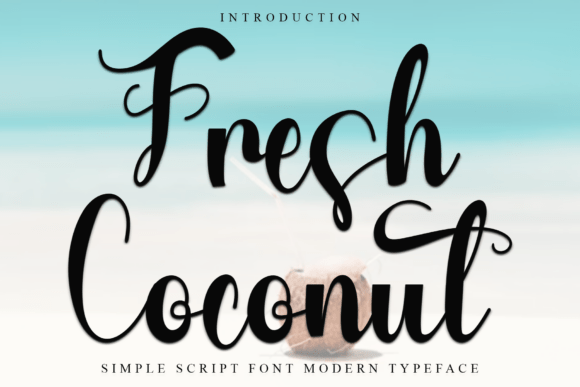
Let’s talk about what makes this typeface so special. Fresh Coconut is a script font with a distinctly casual attitude. Unlike formal calligraphy scripts that require precise spacing and ornate flourishes, this one feels organic and slightly imperfect – in the best way. The strokes are rounded, the terminals are soft, and the overall letterforms have a subtle bounce that mimics natural handwriting. It’s the kind of display font you’d choose when you want your brand to feel like a conversation, not a corporate announcement.
The mood is undeniably friendly. There’s a touch of whimsy, but it’s restrained enough to work for grown‑up products too. I’ve seen similar fonts used on organic food packaging, handmade soap labels, and boutique clothing tags, and Fresh Coconut fits right into that aesthetic. It’s a creative font that doesn’t sacrifice clarity for style. Even at smaller sizes, the letterforms hold their shape well, which is rare for a casual script. This balance makes it a versatile tool for anyone building a brand identity around authenticity and approachability.
Where Fresh Coconut Shines in Your Business Materials
Over the past few months, I’ve experimented with this font across a variety of mockups and real projects. Here’s a quick rundown of where it performs best, and what you might keep in mind for each use case.
- Product labels and packaging: This is the font’s sweet spot. On a honey jar, a candle vessel, or a coffee bag, Fresh Coconut gives the product name a hand‑lettered feel that instantly elevates the perceived value. Because it’s part of the Script Amp collection, it often includes smooth connections between letters, so the wordmark looks cohesive and custom‑made.
- Logos and wordmarks: For small businesses that want their logo to feel personal, this font can serve as the primary typeface. It pairs beautifully with a simple icon or a delicate line illustration. I’ve used it for a florist’s brand mark and a children’s clothing line, and in both cases the feedback was the same: “It feels like us.”
- Menus and café boards: Printed menus or digital ordering screens need to be easy to scan, but they also set the mood. Using Fresh Coconut for section headers – “Pastries,” “Seasonal Drinks,” “Weekend Specials” – adds warmth without making the text hard to read. Keep the body copy in a simple sans serif font for contrast.
- Thank‑you cards and stickers: A handwritten thank‑you note builds loyalty, but when you’re shipping dozens of orders a week, you can’t hand‑write everything. Designing a pre‑printed card with this font gives the impression of a personal message. The same goes for small circular stickers used to seal tissue paper – the lettering looks like a genuine scribble.
- Social media graphics and digital ads: On Instagram, TikTok, or Pinterest, thumbnails and quote cards need to grab attention fast. Fresh Coconut works wonderfully for short, punchy phrases overlaid on product photos. The handwritten feel cuts through the polished, overly‑designed noise of social feeds and feels more like a friend’s recommendation.
- Website headers and banners: For an online shop, the hero banner is often the first impression. A headline set in this font, perhaps saying “Handmade with Love” or “Small Batch Goodness,” sets a cozy, trustworthy tone. Just be sure to use it for the main headline only, not for long paragraphs.
Keeping Your Brand Consistent and Readable
One of the most common mistakes I see small business owners make is using a pretty script font for everything – body text, fine print, ingredient lists. Fresh Coconut is a display font at heart, meaning it’s designed to make an impact at larger sizes. When you shrink it down to 10pt on a mobile screen, the round strokes can start to blend together, and readability suffers. My rule of thumb: if you’re setting more than ten words in a row, switch to a clean, neutral sans serif for the bulk of the text.
That doesn’t mean you can’t use it on small labels; you just need to be strategic. For a lip balm tube, for example, I’ll set the flavor name in Fresh Coconut at a generous size and keep the net weight, ingredients, and contact info in a legible sans serif like Montserrat or Open Sans. The contrast creates a hierarchy that guides the eye naturally. This kind of thoughtful font pairing is what separates a professional design from a cluttered one.
Speaking of pairing, Fresh Coconut is remarkably cooperative. I’ve paired it with a crisp geometric sans serif for a modern, clean look, and with a light serif font for a more editorial, boutique feel. The key is to let the script do the heavy lifting for personality, while the secondary typeface handles the factual information. For a skincare brand, I once used this font for the product name on a jar, and a tall, thin sans serif for the descriptor “Hydrating Facial Cream.” The combination felt both luxurious and approachable.
Practical Tips for Using Fresh Coconut in Real Projects
Before you commit to any font for your business, there are a few practical details to check. Fresh Coconut is a commercial font, which means you can use it on products you sell, client work, and digital downloads – but you should always verify the license terms. Some Script Amp fonts include alternates and ligatures, which are special characters that make the letter connections look more natural. If this font offers those, they’re a game‑changer for logo design. A simple “a” or “s” with a stylish alternate can turn a generic word into a custom signature.
File formats matter too. Most premium fonts come in OTF or TTF formats, and sometimes both. OTF often supports more advanced typographic features like ligatures and stylistic sets. If you’re working with a designer or using software like Canva Pro, Adobe Illustrator, or Photoshop, check that the font files are compatible. Multilingual support is another plus – if you sell internationally or cater to a diverse customer base, accents and special characters (ñ, é, ü) need to be included. I always test this by typing out a few international words in the preview to make sure nothing breaks.
Finally, consider the weight range. Some script fonts come in only one weight, while others have a bold companion. Fresh Coconut’s singular weight is part of its charm – it’s consistent and uncomplicated. But if you need to add emphasis to a word, you might rely on size or color rather than a bolder cut. This limitation isn’t a flaw; it simply means you’ll design with intentionality.
A Small Investment with Big Branding Impact
One of the most rewarding parts of my work is watching a small business go from a scattered visual identity to something that feels cohesive and memorable. Often, the biggest shift comes from a single design decision: choosing a typeface that actually reflects the brand’s personality. Fresh Coconut is the kind of creative font that can pull a whole look together. It’s not trying to be elegant or corporate; it’s trying to be human. And for bakeries, candle makers, boutique owners, content creators, and anyone else who sells a product with heart, that human touch is the ultimate competitive advantage.
Typography might seem like a tiny detail, but it’s one of the first things a customer notices. A font like this signals that you’ve put thought into how your brand feels, not just how it looks. It tells your audience, “I care about the experience of receiving this package, opening this menu, or scrolling past this post.” In a world of mass‑produced everything, that kind of deliberate warmth can turn a casual browser into a buyer, and a buyer into a regular. So if you’re refreshing your packaging, updating your website, or simply trying to make your social media feel more like you, Fresh Coconut is a tool worth exploring. Test it on a few mockups, pair it with a sturdy sans serif, and watch your brand’s personality come to life.